
Your Customer Support Strategy Blueprint
Build a customer support strategy that drives loyalty and growth. This guide covers everything from AI integration to measuring success for exceptional service.
A customer support strategy is your company's official playbook for handling every customer interaction. It's the high-level plan that dictates how your team responds to problems, communicates with users, and works to build real, lasting loyalty with every single ticket, call, and chat.
What Is a Customer Support Strategy?

Think of your customer support strategy as the North Star for your entire customer experience. Without it, your support efforts are just a series of disconnected, reactive decisions. It's like a ship sailing without a rudder-you're moving, but you have no control over the destination. You're just putting out fires as they pop up.
A clear strategy changes everything. It shifts your team from that chaotic "fire-fighting" mode to a structured, proactive approach. Instead of simply closing tickets, you have a guiding philosophy and a set of operational rules that ensure every interaction reflects your brand's promises and pushes your business forward.
More Than Just Solving Problems-It’s About Building Loyalty
At its heart, a customer support strategy is your deliberate plan for creating satisfaction and turning casual buyers into lifelong fans. This isn't just about fixing what's broken; it's about making people feel genuinely heard, valued, and respected. That emotional connection is what separates a forgettable transaction from an exceptional experience that people rave about.
The financial reality is stark. Poor customer service costs U.S. businesses a staggering $75 billion every year. That number alone shows what's at stake. Even with massive spending on new tech, many companies still struggle, which proves that fancy tools aren't a magic fix. If you'd like to dive deeper, you can explore the financial impact of customer service and see just how critical a solid plan is.
To get a better handle on what goes into a great strategy, it's helpful to break it down into its core components. These are the pillars that support every successful support operation.
The Core Pillars of a Winning Support Strategy
A high-level look at the fundamental components that make up a successful customer support framework. These pillars form the basis of our guide.
| Pillar | What It Means in Practice | Primary Goal |
|---|---|---|
| Consistency | Ensuring every customer gets the same quality of care, no matter who they talk to or what channel they use. | Build trust and predictability in the customer experience. |
| Efficiency | Giving your team clear processes and the right tools to solve issues fast, with minimal effort from the customer. | Reduce customer friction and improve operational performance. |
| Improvement | Creating a system to collect feedback, analyze data, and constantly refine your support operations over time. | Adapt to changing customer needs and continuously raise the bar. |
Ultimately, these pillars come together to transform your support team from a simple cost center into a powerful engine for customer retention and business growth.
A support strategy isn't just a document-it's a commitment. It declares that customer happiness is a key performance indicator for the entire business, not just a task for the support department.
This strategic foundation is what everything else is built on. It sets the stage for creating a brand that people don't just buy from, but actively trust and champion.
The Real Business Impact of Proactive Support

It’s easy to think of customer support as a necessary expense-a department that just puts out fires. But a well-thought-out customer support strategy does so much more. It's a direct investment in your company's financial health, capable of turning your support team from a cost center into a serious revenue driver.
The core idea is simple: great support keeps customers coming back. When you solve problems before they escalate and genuinely anticipate what someone needs, you dramatically increase their customer lifetime value (CLV). One single positive interaction can turn a casual buyer into a loyal fan who sticks with you for years. That’s why focusing on retention is one of the smartest financial moves you can make-it always costs more to find a new customer than to keep an existing one happy.
Think of every support ticket, email, or chat as a crossroads. It's a chance to either cement a customer's loyalty for good or send them straight to your competition. A thoughtful, human response can build a reputation that no marketing budget can buy, while a single bad experience can erase months of progress.
The Ripple Effect on Your Bottom Line
A solid customer support plan doesn't just improve things for your customers; it has a huge impact internally, too. When your support agents have clear guidelines, the right tools, and the freedom to make judgment calls, their morale and job satisfaction get a major boost. This creates a wonderful cycle.
A supported team provides superior support. When agents feel valued and empowered, they are far more motivated to go the extra mile for customers. This, in turn, boosts retention and reduces expensive employee turnover within the support department itself.
This internal stability leads directly to a more consistent, high-quality experience for your customers. It's proof that investing in your team is one of the best ways to invest in your customer base.
A proactive strategy also helps you get ahead of common questions. By spotting recurring issues, you can build out resources that let customers find answers on their own-which, frankly, is what many of them prefer. Our guide on how to reduce support tickets with an AI chatbot dives into how you can set up effective self-service options.
A Growing Global Priority
Businesses everywhere are waking up to the real value of strategic customer support, and they're putting their money where their mouth is. We're seeing huge investments in technology designed to create better customer experiences. This isn't just a trend; it's a fundamental change in how successful companies are built.
The global customer service software market was recently valued at around $14.9 billion and is expected to explode to $68.19 billion by 2031. That staggering growth, fueled by a compound annual growth rate (CAGR) of 20.94%, sends a clear message: having a robust customer support strategy is no longer a "nice-to-have."
You can discover more insights about these market trends to see the scale of this shift for yourself. This level of investment shows just how critical support has become for building a resilient, customer-first, and profitable business that lasts.
Building Your Customer Support Framework

Alright, we've covered the basics. Now it’s time to roll up our sleeves and move from theory to action. Building a solid customer support strategy is a lot like constructing a house-it needs a detailed blueprint and the right materials to stand the test of time. This framework is your actionable plan, making sure every single interaction adds to a structure that not only protects but actively grows your brand.
The first step is figuring out what success actually looks like for your team. If your goals are vague, like "making customers happy," your team is essentially flying blind. You need concrete targets that you can actually measure, reflecting both happy customers and an efficient operation.
Define Your Goals and Key Metrics
You can't improve what you don't measure. Setting clear, specific goals is the starting point for any effective customer support strategy. These goals need to be directly linked to your business's bottom line, transforming your support team from a cost center into a powerful hub for customer retention and insight.
So, where do you begin? By identifying the Key Performance Indicators (KPIs) that truly matter.
Common KPIs include:
- Customer Satisfaction (CSAT): This is the classic "How satisfied were you?" question. It’s a direct and simple way to gauge the quality of an interaction.
- First Contact Resolution (FCR): This metric shows you what percentage of issues are solved in a single touch. A high FCR is a huge win-it means your team is efficient and customers aren't stuck in a frustrating loop of follow-ups.
- Average Response Time: This one’s straightforward: how long does a customer have to wait for that first reply? In a world of instant gratification, speed matters.
Once you’ve picked your KPIs, you can set real goals. For instance, you could aim for a CSAT score of 90% or an FCR rate of 75%. These numbers give your team a clear finish line to race toward and create a baseline for tracking improvements over time.
Think of your metrics as the vital signs of your support department's health. They tell you where you’re strong, where you might be struggling, and exactly where to focus your resources for the biggest impact.
Tracking these numbers isn't just for report cards; it’s about digging up real insights that help you refine your entire approach.
Establish a Multi-Channel Support System
Let’s be honest: customers today want to connect with you on their terms, not yours. The old one-size-fits-all model just doesn't cut it anymore. Your strategy has to embrace the different ways people prefer to communicate, whether that’s a quick chat, a detailed email, or an old-fashioned phone call. After all, research shows that 76% of customers would walk away from a brand after just three bad service experiences, and not being able to reach you on their preferred channel is a major source of friction.
Building your multi-channel system is about picking the right tools for your specific audience.
- Email Support: This is the go-to for complex, non-urgent problems that need detailed explanations or file attachments. It also creates a helpful paper trail for everyone.
- Live Chat: Perfect for quick questions and real-time troubleshooting right on your website. AI tools like Whisperchat.ai can handle the initial questions and pass more complex issues to a human agent.
- Phone Support: Still the best option for urgent or emotionally charged situations where the warmth of a human voice can de-escalate tension and build trust.
- Self-Service Knowledge Base: A must-have for customers who'd rather find answers on their own. A well-organized FAQ or help center can deflect a huge number of common tickets and empower your users.
The trick is to make the experience seamless across all these channels. A customer should never have to repeat their story just because they switched from a chat to a phone call.
Create Clear Standard Operating Procedures
At the end of the day, consistency comes from having clear internal rules. Standard Operating Procedures (SOPs) are the playbooks your team relies on to handle day-to-day situations. The point isn't to turn your agents into robots reading from a script; it's to give them a reliable foundation to deliver high-quality service, every time.
SOPs ensure every customer gets the same excellent standard of care, no matter who they talk to. These documents should clearly outline step-by-step processes for common issues, define your brand’s tone of voice, and map out how to escalate tricky problems. When you arm your team with this knowledge, you eliminate the guesswork and free them up to solve problems with confidence and speed.
How to Use AI to Augment Human Support
A modern customer support strategy isn't about choosing between technology and people. It's about blending them intelligently. Think of AI less as a replacement for your team and more as a powerful assistant that helps them do their best work. It's like having a skilled apprentice who handles all the routine, predictable tasks, freeing up your seasoned experts to focus on the unique, high-value work that truly requires a human touch.
This approach is all about augmentation, not just blind automation. By using AI-powered tools like chatbots, you can offer instant, 24/7 answers to common questions. This gives customers with simple needs an immediate solution and saves your agents from the repetitive grind that leads to burnout. They can then dedicate their full energy to the complex, emotionally charged issues where empathy and creative problem-solving are everything.
Balancing Efficiency with a Human Connection
Bringing AI into the mix is a strategic play for efficiency, but it has to be done with care. The real goal is to make your support smarter and faster without losing the genuine human connection that builds lasting customer loyalty. For example, generative AI can be an agent's secret weapon, working quietly behind the scenes.
It can instantly summarize a long, tangled ticket history or draft an on-brand, accurate response. This cuts down the mental load on your team, giving them the space to personalize the final message and resolve issues much quicker. The agent always stays in the driver's seat, making sure the final interaction is both correct and compassionate.
The best AI integration is one the customer never sees, but the agent can't live without. It works in the background to simplify workflows, offer data-backed insights, and empower your team to deliver exceptional service with less effort.
This balanced approach is quickly becoming the industry standard. In fact, some analysts predict that up to 95% of customer interactions will soon be powered by AI technologies. On top of that, around 80% of customer service organizations are expected to bring in generative AI to enhance their capabilities. You can read more about the rise of AI in customer service to get a sense of just how big this shift is.
Practical Steps for AI Integration
Successfully weaving AI into your support operations is more than just flipping a switch. You need a clear plan that puts both the technology and the human experience front and center.
Here’s a practical way to get started:
- Start with High-Volume, Low-Complexity Tasks: Pinpoint the questions your team answers over and over again. These are the perfect job for an AI chatbot, offering the biggest and fastest return on your investment by deflecting simple tickets.
- Train Your AI on Your Data: A chatbot is only as smart as the information you feed it. Use a tool like Whisperchat.ai to train your AI on your own knowledge base, product documentation, and website content. This ensures its answers are accurate and tailored to your business.
- Define a Clear Handoff Protocol: A bot can't solve everything. You need a seamless process for escalating a conversation from AI to a human agent. Make sure the agent gets the full chat transcript so the customer never has to repeat their issue.
- Empower Agents with AI-Assisted Tools: Give your team internal AI features that help them work smarter, not harder. This could be anything from AI-generated summaries of past interactions to real-time response suggestions.
The image below highlights some of the key metrics you can expect to improve with this kind of strategic implementation.
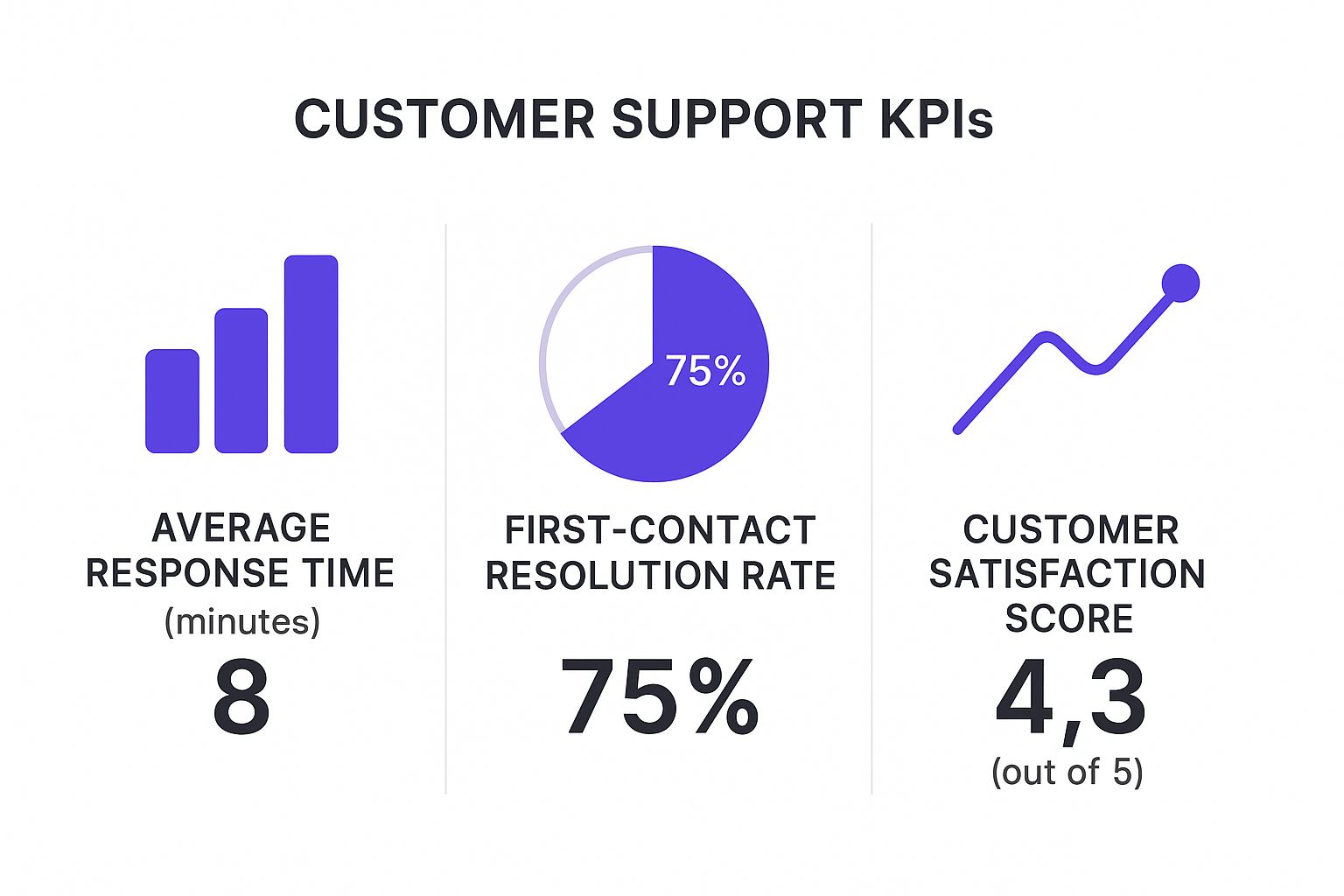
As the graphic shows, optimizing your processes with AI can dramatically lower response times while boosting first-contact resolution and overall customer satisfaction.
Ultimately, integrating AI is about creating a symbiotic relationship. The technology provides the scale and speed, while your human agents deliver the nuance, empathy, and critical thinking that machines just can't replicate. This partnership is the true foundation of an effective and scalable customer support strategy.
Putting Your Customer Support Strategy Into Action
A brilliant customer support strategy on paper is just that-paper. Its real value is only unlocked when you bring it to life through consistent, thoughtful action. This is where the rubber meets the road, where high-level plans become the day-to-day reality of customer interactions. It’s about turning abstract goals into memorable experiences that build real loyalty.
The first step is a mental shift. Stop seeing your support team as people who just close tickets and follow a script. Start seeing them as expert problem-solvers. When your agents feel empowered to make decisions on the spot, they resolve issues faster and add a personal touch that customers genuinely appreciate. This autonomy is the bedrock of a truly responsive support team.
Empower Your Agents to Be Decision-Makers
Your front-line agents are on the front lines for a reason-they're closest to your customers' real-world frustrations and needs. Giving them the authority to make judgment calls, like offering a small discount or approving a workaround without escalating to a manager, can completely turn a negative experience around. It shows customers you trust your team, and by extension, you value the customer's time.
Of course, this isn't about creating a free-for-all. Empowerment needs guardrails to be effective.
- Provide In-Depth Training: Your team needs more than just a script. They need deep product knowledge and a solid grasp of your brand's voice and values.
- Set Clear Boundaries: Let them know exactly what they can do. For example, maybe they’re authorized to issue refunds up to $50 or can offer a specific type of store credit without needing approval.
- Create a Supportive Culture: Encourage agents to take initiative. Make it clear that management has their back when they make a reasonable call, even if one occasionally doesn't pan out perfectly.
This approach doesn't just speed up resolutions. It also builds agent morale and confidence, which naturally leads to better service across the board.
Foster a Customer-Centric Culture Across the Company
For a customer support strategy to truly work, it can't be confined to just the support department. It has to be a company-wide commitment, where every single department understands how it contributes to the customer's journey. The entire customer experience becomes seamless when your product, marketing, and sales teams are all aligned with your support goals.
A customer-centric culture is one where solving customer problems isn't just the support team's job-it's everyone's job. It treats customer feedback not as a series of complaints, but as a priceless source of business intelligence.
Think about it: when the product team regularly reviews support tickets, they get a direct line into what frustrates users, helping them prioritize fixes that actually matter. When marketing understands common support issues, they can craft clearer messaging that sets the right expectations from the very beginning. This kind of collaboration is what separates good support from great support.
Maintain a Consistent and Authentic Voice
Customers don't just interact with your support agents. They see your website, follow your social media, and read your emails. A crucial part of executing your strategy is making sure your brand's tone of voice is consistent and authentic everywhere. This builds trust and makes your brand feel reliable.
Whether it’s a friendly chatbot greeting or a detailed email from a support agent, the language should always sound like it's coming from you. This consistency is especially critical in support interactions, where a calm, empathetic, and clear voice can easily de-escalate a tense situation.
For businesses looking to maintain this consistency at scale, a comprehensive guide to customer support automation can be incredibly helpful. The right tools can reinforce your strategy by giving agents on-brand response templates or powering chatbots that perfectly capture your desired tone. By operationalizing these practices, your customer support strategy becomes a living, breathing part of your business that actively drives customer retention and growth.
How to Measure and Refine Your Strategy Over Time
A great customer support strategy isn't something you create once and then file away. It's a living, breathing plan that needs constant attention. Once you’ve put your strategy into motion, the real work starts-a continuous cycle of measuring what’s working, learning from the results, and making smart adjustments.
Without this feedback loop, even the most brilliant plan will eventually fall out of sync with what your customers truly need. It's like a ship captain navigating without a compass; you're moving, but you have no real idea if you're headed in the right direction. The goal is to transform raw data into genuine intelligence, helping you spot friction points and make improvements that actually matter.
Moving Beyond Basic Satisfaction Metrics
Customer Satisfaction (CSAT) scores are a good starting point, but they don't tell the whole story. To get a complete picture of how your strategy is performing, you need to dig deeper with metrics that reveal the why behind how customers feel. Two of the most powerful are the Net Promoter Score (NPS) and the Customer Effort Score (CES).
- Net Promoter Score (NPS): This metric simply asks customers how likely they are to recommend your business. It's a fantastic indicator of long-term loyalty and the overall health of your brand, looking past single interactions to measure the bigger relationship.
- Customer Effort Score (CES): This measures how easy-or difficult-it was for a customer to get their issue resolved. A low-effort experience is a huge driver of loyalty, because today's customers value speed and convenience above almost anything else.
For instance, a poor CES score is a flashing red light signaling that your support process is too complicated. That single data point gives you a clear mission: find out where the friction is and smooth it out. Maybe your knowledge base is confusing, or perhaps your contact form asks for too much information. To really connect the dots between your support efforts and the bottom line, it's worth exploring other Key Performance Indicators for Customer Service that tie directly to business outcomes.
Turning Insights into Actionable Improvements
Just collecting data isn't enough. The magic happens when you use those insights to make intelligent, deliberate changes to your customer support strategy. This calls for a structured way to review performance and spot opportunities for improvement.
Think of your customer data as a treasure map. Each metric, every piece of feedback, is a clue that points toward a better customer experience. Your job is to follow these clues to find and fix the underlying issues.
This process of continuous improvement is what keeps your support system sharp and relevant. If you want to get into the weeds on the specific numbers you should be tracking, our guide on essential customer support metrics provides a much deeper dive.
The final piece of the puzzle is setting a regular rhythm for reviewing your strategy. Set up quarterly check-ins to analyze trends, celebrate what's going well, and pick one or two key areas to focus on for the next quarter. This focused approach ensures your customer support strategy remains a dynamic, powerful asset that grows and evolves right alongside your customers.
Your Customer Support Strategy FAQ
Even with the best-laid plans, you're bound to hit a few bumps in the road. Let's walk through some of the most common questions and hurdles that pop up when building and rolling out a customer support strategy. Think of these as quick, practical answers to help you move forward with confidence.
How Can a Small Business Create a Strategy with Limited Resources?
When you're a small business, your biggest asset is focus. Don't try to be everywhere at once. Instead of stretching your team thin across a dozen channels, get really, really good at just one or two-like email and phone support. Start by building a simple internal knowledge base for your agents and a solid FAQ page for your website. This will head off a lot of the common, repetitive questions right away.
Your edge isn't a massive call center; it's the personal, responsive service you can offer. Use free or low-cost tools to keep track of issues and see how you're doing. This lean, focused approach is how you build a powerful customer support strategy without breaking the bank.
What Is the Biggest Mistake to Avoid When Launching a New Strategy?
The single most common-and costly-mistake is forgetting about your own team. If you just drop new software and processes on your agents without explaining the why, you’re asking for chaos. You'll end up with confused agents, poor morale, and wildly inconsistent customer service.
The success of any new strategy depends entirely on the people executing it. Your agents must feel confident, supported, and empowered to use the new framework effectively from day one.
Before you go live, invest real time in training. Don't just show them which buttons to click. Explain how the new strategy actually makes their jobs easier and, most importantly, helps create happier customers.
How Often Should We Review Our Customer Support Strategy?
You should do a deep, comprehensive review of your entire strategy at least once a year. This is your chance to zoom out and make sure your support goals still line up with the bigger company vision.
But don't wait a full year to check in. Keep a close eye on your key performance indicators (KPIs) much more often-think weekly or monthly. This constant pulse-check lets you make small, smart adjustments along the way. It’s how you stay nimble and respond to shifts in customer behavior or market changes before they become big problems.
How Do I Get Other Departments to Adopt a Customer-Centric Mindset?
It starts with sharing stories. Make customer feedback-the good, the bad, and the ugly-visible to everyone. Show the product team exactly how a specific bug is frustrating real people. Forward that glowing five-star review to the marketing team so they can see what messaging truly connects.
Position your support data not as a list of complaints, but as a treasure trove of business intelligence that helps everyone do their job better. When other teams see the direct line between their work and a happy, loyal customer, they’re much more likely to embrace a customer-first way of thinking.
Ready to slash support tickets by up to 70% and turn your website into a 24/7 lead-generation machine? With Whisperchat.ai, you can build a custom AI chatbot trained on your own data in minutes. Create your first AI chatbot for free at Whisperchat.ai.