
Customer Support Chatbot: Complete Guide (2026)
Discover how a customer support chatbot can transform your business. This guide covers benefits, types, use cases, and a step-by-step implementation plan.
Think of a customer support chatbot as your most reliable team member. It's a smart program that talks to your customers on your website or through messaging apps, almost like a real person. It works 24/7, handling all the common questions and simple problems on its own. This frees up your human agents to tackle the trickier issues that really need their expertise.
What Is a Customer Support Chatbot and Why You Need One
Let's cut through the jargon. You know those frustrating automated phone menus where you have to "press one for sales"? A modern chatbot is the exact opposite of that. It’s conversational, intuitive, and genuinely helpful. It’s like cloning your best employee-someone who knows everything, never gets tired, and is always ready to help.
This isn’t just a cool piece of tech; it’s a direct answer to how customer expectations have changed. People today expect answers now. A few minutes of waiting can feel like an eternity, leading to frustrated customers and lost sales. The days of waiting hours for an email reply or being stuck on hold are over.
The New Standard for Service
A customer support chatbot nails this new reality by delivering instant help whenever it’s needed. Instead of making someone dig through a messy FAQ page, the bot serves up the right answer right away, all within a simple chat window.
This creates a clear win-win for everyone involved: your customers are happier, and your team is more effective.
- For the Customer: They get instant answers to questions about their order status, shipping times, or return policies. This builds immediate trust and satisfaction.
- For Your Business: Your human agents are no longer stuck answering the same five questions a hundred times a day. They can now focus their skills on complex, high-impact conversations that require a human touch.
A chatbot masterfully balances enhancing the customer journey with driving serious operational efficiency. It's not just a tool for deflecting tickets; it's a core component of a modern customer service strategy that boosts both satisfaction and the bottom line.
Immediate Wins with a Modern Customer Support Chatbot
The table below breaks down the immediate benefits you can expect when you bring a customer support chatbot into your workflow. It highlights the direct, positive changes for both your business operations and your customers' experience.
| Benefit | Impact on Business | Impact on Customer |
|---|---|---|
| 24/7 Availability | Provides round-the-clock support without increasing staff costs. | Gets instant answers anytime, day or night. |
| Instant Responses | Drastically reduces first-response times and ticket backlogs. | No more waiting on hold or for an email reply. |
| Scalability | Handles thousands of conversations at once without a drop in performance. | Receives immediate help even during peak business hours. |
| Cost Efficiency | Automates up to 80% of routine inquiries, lowering support overhead. | Experiences a smooth, frictionless support journey. |
| Data Collection | Gathers valuable insights into common customer pain points and questions. | Contributes to service improvements without filling out long surveys. |
As you can see, the value isn't just theoretical. These are tangible improvements that directly address key business challenges while giving customers the speedy, effortless service they demand.
Fueling Business Growth
It's clear why these tools are catching on so quickly. The global market for customer support chatbots is booming, projected to leap from $2.47 billion in 2021 to a staggering $15.57 billion by 2025. This explosion is happening because businesses of all sizes are seeing the incredible return on providing automated, on-demand support. You can explore more insights about chatbot market growth to see just how foundational this technology has become.
At the end of the day, having a customer support chatbot isn't a futuristic luxury anymore-it's essential for staying competitive. It solves the modern customer's need for instant answers while making your entire operation smarter and more scalable.
What You Actually Gain by Automating Customer Support

Knowing what a customer support chatbot is just scratches the surface. The real question is, what’s in it for your business? Why are they becoming so essential?
Automating support isn't about just cutting down on manual work. It’s a strategic shift that pays dividends in three critical areas: your team's efficiency, your customers' happiness, and your company's bottom line. Think of a chatbot as a force multiplier for your support team. It takes on all the repetitive, high-volume questions that bog agents down, freeing them up to tackle the tricky, nuanced problems where a human touch really matters.
Skyrocket Your Operational Efficiency
The first and most obvious win is a massive jump in efficiency. Picture a system that can answer thousands of questions at the same time, around the clock, without ever getting tired or making a typo. That’s what a chatbot brings to the table.
This kind of automation smashes through common bottlenecks. Instead of scrambling to hire more people for your busy season, a single bot scales up instantly to handle the rush. No customer gets left waiting, your budget is freed up, and your existing team isn't constantly under pressure. That means less burnout and happier, more engaged agents.
The numbers back this up. Top-tier AI chatbots can successfully handle up to 80% of routine customer questions. This creates a powerful ripple effect. Companies like Lyft have seen average resolution times drop by a staggering 87%. When human agents have AI helping them out, they resolve 15% more issues every hour. Check out more statistics on AI's impact to see just how big the difference can be.
Create a Stellar Customer Experience
Efficiency is great, but not if it comes at the expense of your customer experience. The good news is that a well-designed chatbot actually makes customers happier by delivering exactly what they want: speed, accuracy, and convenience.
In an on-demand world, forcing a customer to wait for an answer is a fast track to losing them. A chatbot completely removes that friction.
- Instant Answers: Customers get help the moment they need it, 24/7, without ever sitting in a queue.
- Consistent Information: The bot delivers the same correct, on-brand answer every single time. No more risk of human error or conflicting advice.
- Effortless Self-Service: It puts customers in the driver's seat, letting them find solutions on their own terms. This transforms support from a chore into a smooth, self-guided experience.
The goal is to make getting help feel effortless. By providing immediate and accurate answers around the clock, a chatbot shows customers that you respect their time, which is one of the most powerful ways to build lasting loyalty and trust.
Fuel Sustainable Business Growth
Finally, the impact of a chatbot reaches far beyond the support team. When you improve efficiency and make customers happier, you’re actually building a powerful engine for business growth. A customer who has a great support experience is far more likely to buy from you again, leave a positive review, and tell their friends about you.
On top of that, every conversation is a goldmine of data. Chatbots are fantastic at collecting feedback on what your customers are asking, the problems they’re running into, and what they’re interested in. This gives you a direct line to insights you can use to improve your products, update your help docs, and sharpen your marketing.
A chatbot can even play an active role in sales. It can identify potential leads, ask a few qualifying questions, and even book a demo or a call with your sales team. This turns your support channel into a proactive tool for generating revenue. To learn more, explore our guide on the full range of benefits of using AI chatbots for business. It all comes down to a simple truth: better support builds a better business.
Understanding How Different Chatbots Work
Not all chatbots are created equal. When you start exploring customer support chatbots, it feels a lot like you're hiring for a new role. Do you need a diligent assistant who follows a script to the letter, or an experienced detective who can think on their feet?
These two "employees" represent the fundamental split in chatbot technology: rule-based systems and AI-powered conversationalists. Knowing the difference is key to picking the right tool for your business. One is a master of predictable, straightforward tasks, while the other thrives on complexity and nuance.
The Reliable Script Follower: Rule-Based Chatbots
A rule-based chatbot operates like a highly organized flowchart. Think of it as an interactive phone menu brought to life in a chat window. It’s built on a series of predefined rules and a decision tree. If a customer asks "X," the bot is programmed to respond with "Y." It's that simple.
This kind of customer support chatbot is at its best in controlled environments where you can predict most of the questions your customers will ask. We’re talking about common, repetitive queries that have simple, fixed answers. The bot guides the user down a specific path, often using buttons and pre-set options to make sure the conversation stays on track.
Here’s a look at their core characteristics:
- Predictable and Consistent: They give the exact same answer to the same question, every single time. No surprises.
- Simple to Build: Since they don't rely on complex AI, these bots are generally faster and cheaper to set up.
- Limited Scope: They get stuck when a question falls outside their script. Typos, slang, or unusual phrasing can easily confuse them.
For a simpler, yet still effective, form of automated customer interaction, an autoresponder for text messages operates on a similar principle. This approach mirrors the direct, trigger-and-response logic that powers rule-based systems, offering a solid starting point for basic automation.
The Intelligent Detective: AI-Powered Chatbots
AI-powered chatbots are in a completely different league. Instead of following a rigid script, they use advanced tech like Natural Language Processing (NLP) and machine learning to understand what a user is actually trying to say, no matter how they phrase it.
Think of an AI bot as a detective. It doesn't just register keywords; it analyzes the clues-the context, the user’s intent, and even their sentiment-to figure out the real problem. This allows it to handle a much wider and more complex range of conversations, making the whole interaction feel more natural and human-like.
AI chatbots go beyond simple keywords. They interpret user intent, learn from past interactions, and adapt their responses, creating a dynamic and genuinely helpful customer experience that a scripted bot simply cannot match.
This infographic shows how a modern dashboard helps you track the key metrics that really show off an AI chatbot's performance.
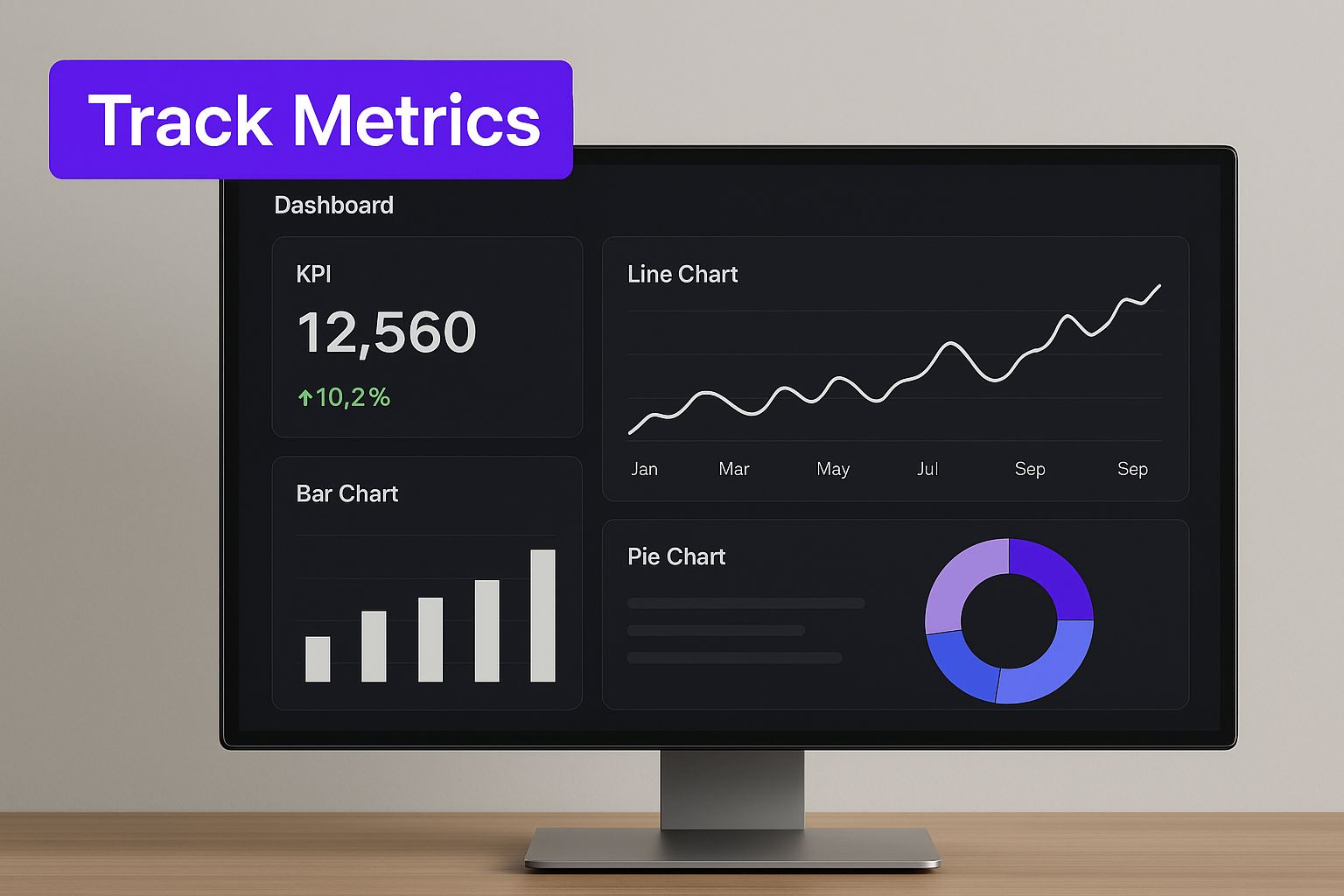
By keeping an eye on metrics like resolution rate and customer satisfaction, businesses can clearly see the superior problem-solving power of an AI-driven system.
This advanced capability allows them to tackle much more sophisticated tasks.
- Understand Context and Intent: They can figure out what a user wants even if the question is poorly worded or has typos.
- Learn and Improve: These bots get smarter over time. They learn from every single conversation to provide better, more accurate answers in the future. In fact, a 2025 survey found the use of generative AI in customer service chatbot platforms jumped from 30% to 40% in just one year, a clear sign that businesses are rapidly adopting this smarter tech.
- Handle Complex Queries: They can navigate multi-step problems, remember what was said earlier in the conversation, and offer personalized solutions.
Choosing the Right Tool for the Job
So, which one is right for you? The decision really comes down to your specific goals and how complex your customers' needs are. A rule-based bot is a fantastic starting point for handling a high volume of simple, identical questions, like "What are your store hours?" or "Where's my order?"
But if you want a customer support chatbot that can troubleshoot tricky issues, provide personalized product recommendations, or handle nuanced support requests, an AI-powered solution is the clear winner. They take more effort to set up, but their ability to deliver truly intelligent and adaptive conversations provides a much greater return on investment for any business serious about delivering an exceptional customer experience.
How Top Companies Use Chatbots to Win Customers
It's one thing to talk about chatbots in theory, but seeing them in action is where you really grasp their power. Across the board, smart companies aren't just using bots to field questions. They're deploying them as strategic tools to solve specific business headaches, drive sales, and build the kind of loyalty that keeps customers coming back.
Think of these bots as highly specialized assistants, custom-built for the job. For an online store, the bot is a personal shopper. For a software company, it's a tireless onboarding guide. Each application shows how this technology can be a genuine game-changer when applied correctly.
E-commerce Bots Driving Sales and Satisfaction
In the hyper-competitive world of online retail, personalization and speed are the name of the game. E-commerce chatbots are brilliant at both. They provide instant answers to the simple, repetitive questions that used to bury support teams-things like, "Where is my order?" or "Can I return this?"
That kind of immediate help is fantastic for preventing abandoned carts and keeping shoppers happy. But today's bots have evolved far beyond simple package tracking. They've become potent sales engines.
- Personalized Recommendations: By looking at a customer’s browsing patterns, a chatbot can suggest products they’ll genuinely love, acting just like a helpful shop assistant.
- Proactive Engagement: Ever see a customer lingering on a product page? The bot can pop up with a timely discount offer or ask if they have any last-minute questions, giving them that final nudge to click "buy."
- Seamless Order Management: Customers can start a return, check a refund status, or even change an order right inside the chat window. It makes the whole post-purchase experience feel effortless.
SaaS Companies Onboarding and Retaining Users
For any Software-as-a-Service (SaaS) business, that initial onboarding phase is make-or-break. A confused new user is a user who is likely to cancel their subscription. This is where chatbots have become absolutely essential, guiding people through the setup process so they see the product's value from day one.
Instead of making someone dig through a clunky knowledge base, a customer support chatbot can offer interactive, step-by-step guidance right when it's needed.
A chatbot in a SaaS setting is like having an on-demand product expert available 24/7. It can troubleshoot technical issues, break down complex features, and gather user feedback, all without needing a human to step in. This ensures users get the help they need to succeed, no matter the time of day.
This hands-on approach takes a huge load off your human support agents and, more importantly, makes users feel empowered. When people can solve their own problems quickly, they're far more likely to stick around. As you build out your own support strategy, it's worth taking the time to compare the nuances of a chatbot vs live chat to see where each one fits best.
A Quick Look at How Industries Use Chatbots
Chatbots aren't a one-size-fits-all solution; their value comes from being adapted to solve industry-specific problems. From streamlining bookings in travel to handling claims in insurance, the applications are incredibly diverse.
Here’s a comparative look at how different industries put customer support chatbots to work.
Chatbot Use Cases Across Industries
| Industry | Primary Use Case | Key Objective |
|---|---|---|
| E-commerce | Product recommendations & order tracking | Increase sales & reduce support tickets |
| SaaS | User onboarding & feature guidance | Improve user activation & reduce churn |
| Financial Services | Account inquiries & fraud alerts | Enhance security & provide 24/7 access |
| Healthcare | Appointment scheduling & FAQ answers | Improve patient experience & free up staff |
| Travel & Hospitality | Booking assistance & trip modifications | Streamline reservations & offer instant support |
| Real Estate | Property inquiries & lead qualification | Capture leads & provide instant property info |
As you can see, the core function shifts to meet the primary need of the customer in that context-whether that’s making a purchase, learning software, or checking a bank balance.
Financial Institutions Building Trust with Security
In the world of finance, trust and security are everything. Banks, credit unions, and insurance companies use chatbots to provide customers with secure, immediate access to their information, which frees up human agents to handle more complex financial advisory roles.
These bots are trained to manage a range of secure tasks with total precision.
- Balance Inquiries: Customers can get a quick snapshot of their account balance or see recent transactions within a secure chat.
- Fraud Alerts: A chatbot can instantly flag suspicious activity and walk a customer through the steps to lock down their account.
- Policy Questions: Users can get straight, simple answers about their insurance coverage or loan details without having to wait on hold.
By automating these routine yet crucial interactions, financial institutions are able to offer a much more responsive and modern customer experience. This isn't just a niche trend. Recent data shows that nearly 90% of CX leaders find chatbots most valuable when they guide customers to the right products and services. That same report found that the use of generative AI in these bots shot up from 30% to 40% in just one year, signaling a major move toward more intelligent automation. You can dig into the full data on chatbot trends in CX for a deeper look.
How to Implement Your First Customer Support Chatbot
Bringing a chatbot into your customer support workflow might sound like a massive technical project, but it’s much more manageable when you see it for what it is: training a new, incredibly efficient team member. If you approach it with a clear plan, you can get it working for you and your customers right from the start.
The whole journey really begins with a simple question: what problem are we trying to solve? Without a good answer, it’s easy to get sidetracked. A successful launch isn't just about sticking a chat widget on your website; it's about solving real-world headaches for your customers and freeing up your team.
Define Clear and Measurable Goals
Before you even start window shopping for chatbot platforms, you need to know what success looks like. Vague goals like "improve customer service" are useless because you can't measure them. Get specific.
Think in terms of real numbers and outcomes you can actually track. This clarity will be your North Star for every decision that follows, from the software you pick to the conversations you design.
- Reduce Ticket Volume: Aim to cut down routine support tickets by a tangible number, like 30%, in the first three months.
- Improve First-Response Time: Your goal could be to slash the average wait time for common questions from hours down to under a minute.
- Increase Lead Generation: What if the bot could boost qualified leads by 15%? It can, by simply asking for contact info at the right moment.
- Boost Self-Service Rates: Track how many customers get their answers from the bot without ever needing to speak to a person.
Setting these kinds of benchmarks gives you a concrete way to see your return on investment and prove the project's value to your organization.
Choose the Right Chatbot Platform
With your goals locked in, it's time to find the right tool for the job. The market is packed with options, from basic, rule-based bots to incredibly smart AI platforms. The right choice for you will depend entirely on your goals, your team's technical skills, and your budget.
When you're comparing platforms, keep these factors in mind:
- Ease of Use: Is it a no-code or low-code solution? You want something your customer support manager can use, not just your developers.
- Training Capabilities: How easy is it to teach the bot? The best platforms let you feed it information directly from your website, FAQs, and internal documents.
- Integration Options: Make sure it plays nicely with the tools you already use, like your CRM or help desk software. You need a seamless workflow, not another silo.
- Customization: Can you make it look and sound like your brand? A consistent voice and appearance are non-negotiable for a good customer experience.
The best platform is one that can grow with you. It’s smart to start with a tool that solves today’s problems but also has the power to handle more complex tasks down the road.
Design a Natural and Helpful Conversation
This is the creative part-where you give your chatbot a personality. The goal is to make interactions feel helpful and human, not clunky and robotic. A great place to start is by digging into your existing support tickets and FAQ pages. They're a goldmine for understanding what your customers actually ask.
Once you have a list of common questions, craft clear and concise answers for each one. Try to think one step ahead and anticipate what the user might ask next.
- Create a Welcoming Greeting: The first message should be friendly and immediately set expectations about what the bot can help with.
- Use a Clear Escalation Path: Never trap a user in a conversation. Make it painfully obvious how they can talk to a human if they need to. A simple "Talk to an agent" button is a must.
- Keep Responses Short and Scannable: No one wants to read a wall of text in a chat window. Use bullet points, short sentences, and even emojis to keep things light and digestible.
Getting this right is fundamental to building an effective digital assistant. If you want to go even deeper, our guide on how to implement a chatbot for business growth breaks down these strategic steps in much more detail.
Train, Test, and Launch Your Chatbot
You've designed the conversations, and now it's time for the most important step: training. For a modern AI chatbot, this means feeding it your knowledge base-your website content, product manuals, help docs, and policy PDFs. The AI ingests all of this to learn how to answer questions accurately. It’s simple: the better the data you give it, the smarter it becomes.
Next, you have to test it. And I mean really test it. Don't just ask the easy questions. Try to confuse it. Ask weird questions, use slang, make typos. This internal stress-testing is your chance to find and fix any awkward phrasing or wrong answers before your customers do.
When you're confident, you're ready to launch. But the job isn't done. A great chatbot isn't launched; it's raised.
Monitor, Analyze, and Optimize Performance
Once your chatbot is live and talking to real customers, it starts generating a ton of useful data. You need to get in the habit of regularly checking conversation logs and performance reports to see what’s working and what’s falling flat.
Keep a close eye on these metrics:
- Resolution Rate: What percentage of conversations does the bot handle successfully on its own?
- Escalation Rate: How often are people asking to speak to a human?
- Customer Satisfaction (CSAT) Scores: After a chat, are users happy with the help they got?
- Unanswered Questions: What questions are stumping your bot? This is a clear signal that you need to fill a gap in its knowledge base.
Use these insights to constantly tweak your bot's answers, add new information, and improve its conversational skills. A customer support chatbot isn't a "set it and forget it" project. It's a living part of your team that gets smarter and more valuable with every single customer interaction.
Frequently Asked Questions
It’s completely normal to have questions before bringing a customer support chatbot into your business. It's powerful technology, for sure, but getting a handle on the practical details is what leads to a confident decision. We've gathered the most common questions we hear from business leaders and answered them head-on.
Think of this as the final briefing before you move forward. We'll cover everything from real-world costs to how you can actually prove the tool is working.
How Much Does a Customer Support Chatbot Cost?
The cost of a chatbot can swing wildly, kind of like the difference between buying a simple hand tool and commissioning a custom-built machine. The final price tag really boils down to how complex and capable you need it to be.
Simpler, rule-based chatbots often come with a monthly subscription that can be as low as $50 to $100. These are great for automating basic FAQs. On the other end of the scale, a custom-built AI chatbot with deep integrations into your other systems (like your CRM) and advanced language skills can require an upfront investment anywhere from $5,000 to over $100,000, plus ongoing costs for maintenance.
The price is a direct reflection of the chatbot's intelligence. Key cost drivers include its AI sophistication, the number of systems it needs to connect with, and the complexity of the conversations it's expected to handle.
Can a Chatbot Replace My Human Support Team?
Absolutely not, and that shouldn't even be the goal. The best-run support operations use a hybrid model where chatbots make the human team more powerful, not redundant. Think of the bot as your team's first line of defense.
Chatbots are brilliant at handling the high volume of repetitive, simple questions that eat up so much of a support agent's day-things like "Where is my order?" or "How do I reset my password?" This clears the queue, freeing up your human experts to focus their energy on the complex, high-value customer problems that require empathy and critical thinking.
Any good chatbot setup must have a seamless, obvious way to hand a conversation over to a person. The bot has to know its limits and pass the baton without a fuss.
How Do I Measure Chatbot Success?
You'll want to look at a mix of performance data and customer-focused metrics. You need to know if the bot is doing its job efficiently and if your customers are walking away happy.
Here are the key things you should be tracking:
- Resolution Rate: What percentage of conversations does the chatbot solve all on its own, without needing a human? A high resolution rate is a great sign it's handling the routine stuff effectively.
- Escalation Rate: The flip side of the resolution rate. This tells you how often a human has to jump in. If this number starts creeping up, it might mean there's a gap in the bot's knowledge that needs filling.
- Customer Satisfaction (CSAT): Nothing beats direct feedback. A simple post-chat survey asking customers to rate the experience will tell you how helpful they found the interaction.
- Goal Completion Rate (GCR): Did the bot actually do what it was supposed to do? This metric tracks whether it successfully helped a user complete a specific task, like tracking an order or finding a document.
Keeping an eye on these KPIs will give you a clear picture of your return on investment and show you exactly where you can tweak the bot's performance over time.
What Is the Difference Between a Chatbot and Conversational AI?
People often use these terms interchangeably, but there’s a real difference. "Chatbot" is the broad, umbrella term for any program designed to simulate a conversation-even the most basic, scripted ones.
"Conversational AI," on the other hand, is a much more advanced kind of chatbot. It uses sophisticated tools like Natural Language Processing (NLP) and machine learning to understand not just words, but intent, context, and even the user's mood.
Here’s a simple way to think about it:
A basic chatbot is like someone following a script. It can only give pre-programmed answers and gets confused if you go off-topic. Conversational AI is like an experienced improv actor who understands the nuances of a conversation and can adapt their responses in real time.
In short, all conversational AI tools are chatbots, but not all chatbots are smart enough to be called conversational AI. The latter can handle unscripted, complex dialogue and actually learns from its interactions to get better over time.
Ready to see how an intelligent, no-code chatbot can transform your customer support? With Whisperchat.ai, you can train a powerful AI assistant on your own documents and website content in minutes. Start automating answers, delighting customers, and freeing up your team today. Build your first chatbot for free!