
Measuring Customer Satisfaction: Proven Strategies for Success
Learn effective methods for measuring customer satisfaction. Discover key metrics like NPS and CSAT to enhance feedback and drive growth.
Measuring customer satisfaction is all about figuring out how happy people are with your products, services, and the entire experience you provide. Think of it less as a fluffy, feel-good exercise and more as a critical business tool. It’s the direct line connecting how your customers feel to real-world results like retention, loyalty, and, most importantly, revenue growth.
Why Measuring Satisfaction Is Your Growth Engine

Let’s get one thing straight: understanding customer sentiment isn't just a "nice-to-have." It’s the engine that powers your company's health and stability. The smartest companies I've seen don't treat feedback as a cost center-they see it as their most valuable lever for growth. This mindset is everything, because customer happiness is a leading indicator of what’s coming down the road.
A small dip in satisfaction scores today can signal a huge revenue risk six months from now. When you’re actively gathering and digging into feedback, you're not just collecting numbers. You’re building an early-warning system that flags potential churn, spots operational hiccups, and shines a light on gaps in your product before they become massive problems.
The Link Between Feeling and Spending
The connection between how a customer feels and whether they'll stick around is incredibly strong. Here’s a hard truth: a "satisfied" customer isn't automatically a loyal one. Satisfaction often just means their basic expectations were met-that nothing went horribly wrong. That's a pretty low bar for building a real relationship.
True loyalty and the repeat business that comes with it are born from experiences that are genuinely memorable and personal. You have to exceed expectations, not just meet them.
The financial hit for getting this wrong is staggering. Bad service is a deal-breaker for most people. In fact, research shows that 89% of eCommerce consumers have stopped buying from a brand after just one poor experience. And we all know that getting a new customer costs way more than keeping a current one. If you want to dig deeper, you can discover more insights on the cost of poor service and the massive benefits of retention.
A "fine" or "satisfactory" experience is completely forgettable. Customers don't rave about adequacy; they talk about experiences that genuinely impressed them. If you only aim for satisfaction, you're making it easy for a competitor who aims for delight to steal your business.
The Foundation for a Resilient Brand
When it comes down to it, measuring customer satisfaction is how you build a business that can weather any storm. It's about more than just putting out fires; it’s about proactively creating positive experiences that become your primary driver of growth.
A deep understanding of satisfaction helps you do three things exceptionally well:
- Retain more customers: You can spot and fix pain points long before they cause someone to leave.
- Boost revenue: Happy customers buy again, try your new offerings, and ultimately spend more over their lifetime.
- Strengthen your brand: Consistently great experiences create a powerful reputation that brings in new customers through word-of-mouth alone.
By committing to this process, you stop guessing and start making smart, data-informed decisions that build a much stronger and more profitable business.
Choosing the Right Satisfaction Metrics
Before you can improve customer satisfaction, you have to measure it. But picking the right metric is more than just a technical step-it’s about deciding what you truly want to know about your customer's experience. Think of it like a doctor choosing a diagnostic tool. You wouldn't use a stethoscope to check someone's vision.
The big three in the world of customer feedback are Customer Satisfaction Score (CSAT), Net Promoter Score (NPS), and Customer Effort Score (CES). Each one tells a different part of the story, and experienced teams know how to use them together to get a complete picture.
Here's a look at how these metrics can play out in the real world, showing why tracking just one isn't enough.
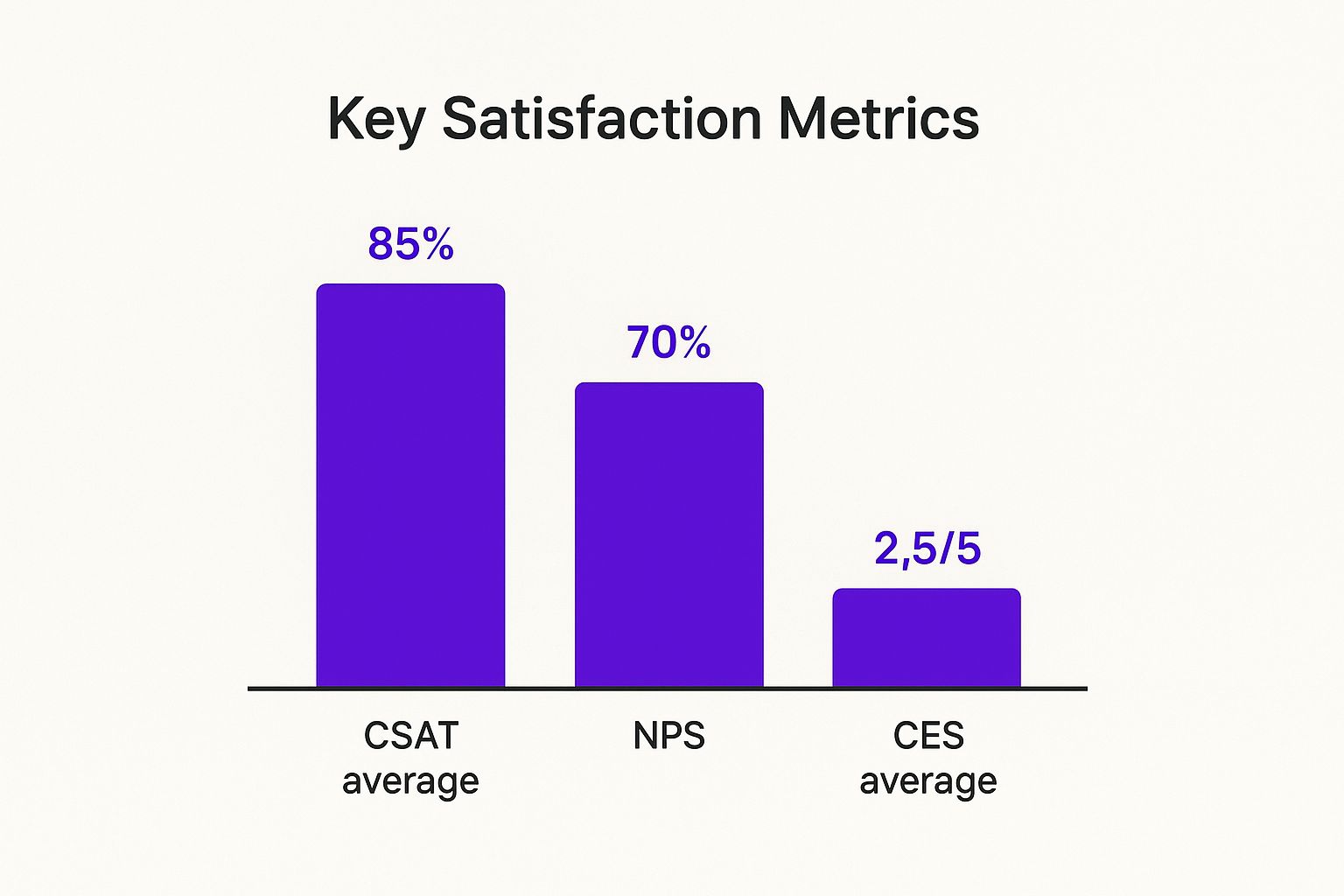
As you can see, a company might be doing great on individual interactions (CSAT) but falling short on building long-term advocates (NPS). This is a classic sign that you're solving problems well in the moment but not creating a truly memorable brand experience.
Comparing Key Customer Satisfaction Metrics
To get this right, you have to ask the right question at the right time. Using the wrong metric for a situation is a surefire way to get misleading data and make poor decisions.
Here’s a simple breakdown of the big three metrics, what they measure, and when you should use them.
| Metric | What It Measures | Typical Question | Best Used For |
|---|---|---|---|
| CSAT | Short-term happiness with a specific interaction or product. | "How satisfied were you with your recent support chat?" | Immediately after a specific touchpoint, like a purchase, delivery, or support ticket resolution. |
| NPS | Long-term customer loyalty and willingness to advocate for your brand. | "How likely are you to recommend our company to a friend or colleague?" | Periodically (quarterly or annually) to gauge overall brand health and customer relationship strength. |
| CES | The ease of a customer's experience and the friction involved in a task. | "How easy was it to get your issue resolved today?" | After problem-resolution interactions, like using a help center or contacting support. |
Each metric provides a unique lens. CSAT gives you that instant, in-the-moment feedback. NPS offers a high-level view of brand loyalty. And CES-my personal favorite for predicting repeat business-tells you if you're making life easier or harder for your customers.
For a deeper dive into these and other critical benchmarks, check out our complete guide on customer support metrics.
Beyond a Good Score to Genuine Loyalty
Here’s a hard truth: a high satisfaction score doesn't automatically equal loyalty. It's a great start, but it's not the finish line.
Recent XM Institute research shows that while global consumer satisfaction is a respectable 76%, key loyalty indicators like trust and repurchase intent are lagging. There’s a dangerous gap between a customer being "satisfied" and being truly loyal. You can explore the full research on global satisfaction trends to see the data for yourself.
An experience that's just "fine" or "satisfactory" is utterly forgettable. Customers don't rave about adequacy. They tell stories about the times a company went the extra mile and made them feel valued. If you only aim for satisfaction, you're leaving the door wide open for a competitor who aims for delight.
This is why a multi-metric approach is so powerful. A high CSAT score tells you your team is handling individual touchpoints correctly. A rising NPS confirms that those positive interactions are adding up to build real brand affinity. And a low CES ensures the entire journey feels effortless-which, in today's world, is what truly keeps people coming back.
Designing Surveys People Actually Answer

So, you've picked your metric. That's a great start, but it's only half the battle. Now you have to design a survey that customers will actually take the time to complete. After all, a brilliant question is useless if it's buried in a clunky, confusing survey that gets ignored.
The single most important principle here is respecting your customer's time. A survey is an interruption, no matter how you slice it. Your job is to make it a brief and painless one. Forget those long, soul-crushing questionnaires with dozens of questions. For most transactional feedback, a single, focused question is often all you need.
Keep It Simple and Neutral
The way you word your questions has a massive impact on the answers you get. It’s surprisingly easy to accidentally lead your customers toward a specific response, which poisons your data.
- Bad Question: "How much did you love our amazing new feature?" This is just fishing for compliments.
- Good Question: "How satisfied were you with the new feature?" This is a neutral query seeking an honest opinion.
The goal is to gather genuine feedback, not to pat yourself on the back. Stick to clear, simple language that anyone can understand, steering clear of internal jargon.
You also have to assume every survey will be opened on a phone. Your design must be mobile-friendly. That means large fonts, easy-to-tap buttons, and minimal scrolling. If it’s a pain to complete on a small screen, most people will just give up.
A classic mistake is trying to ask everything at once. This always backfires and leads to high abandonment rates. Focus on one goal per survey. If you want CSAT on a recent support ticket, ask only about that. Don't tack on unrelated questions about your marketing or product pricing.
Strategic Timing and Channels
When and where you ask for feedback is just as critical as what you ask. The context of the request can make or break your response rate. For example, hitting someone with an NPS pop-up the second they land on your homepage for the first time is premature and just plain annoying.
You need to match the timing and channel to the specific interaction you're measuring.
- For CSAT: The best time is immediately after an interaction. Use an in-app prompt or a follow-up email right after a support chat closes or a customer makes a purchase. The experience is still fresh in their mind.
- For CES: Trigger this survey right after a customer completes a specific task, like using a self-service tool or navigating your return process. You want to capture their immediate feeling of ease or frustration.
- For NPS: This is a relationship metric, so don't send it after every transaction. An email sent quarterly or annually gives customers enough time to form a holistic opinion about your brand.
Choosing the right channel is also key. In-app surveys work beautifully for SaaS products where users are already engaged. For an e-commerce brand, sending an email a few days after delivery gives the customer time to actually try out the product. A little experimentation here will help you build a feedback system that provides a steady stream of valuable data.
From Raw Data to Real Insights
Getting customer feedback is just the first step. The real magic happens when you transform that flood of survey scores and open-ended comments into intelligence you can actually use to steer the business. Let's be honest, an unanalyzed NPS or CSAT score is just a number. The gold is hiding in the patterns and stories behind that number.
Your journey starts by looking past the overall average. Sure, that aggregate score gives you a decent temperature check, but the most powerful insights are almost always found when you start slicing the data. Segmenting your responses is how you pinpoint exactly where your customer experience is hitting the mark-and where it's falling apart.
Uncovering Hidden Patterns
Start by carving up your data into meaningful groups. This is how you compare experiences across different corners of your customer base and spot friction points you’d otherwise completely miss.
Think about it this way:
- By Customer Type: Are your brand-new customers giving you lower satisfaction scores than your long-time loyal clients? That could be a huge red flag pointing to a clunky or confusing onboarding process.
- By Purchase History: Do customers who buy one particular product consistently seem less happy? You might have a product flaw on your hands, or maybe your marketing is setting expectations that reality can't meet.
- By Support Agent: Does one support agent consistently rake in higher CSAT scores? Find out what they're doing differently. That isn't about calling anyone out; it's about finding what works and turning it into a best practice for the whole team.
To truly connect the dots between feedback and your bottom line, you have to get comfortable with mastering customer experience analytics. This is the discipline that turns raw feedback into operational improvements.
The financial stakes here are massive. US companies reportedly lose an estimated $75 billion each year just from poor customer service. That staggering figure should be all the motivation you need to dig into your feedback and act on it.
Analysis without action is just an expensive hobby. The goal isn't to create pretty reports; it's to create change. Every insight you uncover should be tied to a potential improvement, whether it’s a tiny tweak to your website copy or a major overhaul of your returns process.
The Art of Closing the Loop
One of the most powerful things you can do is close the loop, especially with unhappy customers. When someone takes the time to give you negative feedback, they're handing you a gift-a clear opportunity to fix a problem and maybe even save the relationship. Ignoring it is one of the fastest ways to lose a customer forever.
A quick, personal follow-up can genuinely turn a detractor into a fierce advocate. Here’s a simple way to approach it:
- Acknowledge and Thank: First, thank them for their feedback, even if it was harsh. Mention their specific issue so they know you actually read their comment.
- Apologize and Empathize: Offer a real apology for their bad experience. Show you get it by saying something like, "I can absolutely understand why that would be so frustrating."
- Explain and Resolve: Briefly explain what happened (if you know) and, more importantly, what you’re doing about it. This could be a fix just for them or a bigger change you're making because of what they shared.
For instance, a great response might sound like this:
"Hi Alex, thank you so much for your feedback about the slow delivery. I'm truly sorry for the delay and I can see how frustrating that must have been. We've actually identified an issue with our shipping partner in your area and are working to get it sorted. As a small thank you for your patience, we've added a credit to your account for your next order."
This kind of response shows you're not just listening-you care enough to act. It's that proactive follow-up that rebuilds trust and can transform a negative moment into a surprisingly positive one.
Turning Feedback into Business Improvements

This is where the rubber meets the road. All the data you've gathered is just a collection of numbers until you use it to make tangible changes that actually improve your business. It's about closing the loop and building a clear path from what your customers are telling you to what you’re going to do about it.
Your first job is to get leadership on board. Don't just walk into a meeting with a slide full of raw scores. You need to tell a compelling story. For instance, connect a dip in CSAT scores for a particular feature to a spike in support tickets, or show how a low NPS directly correlates with a drop in repeat purchases from a high-value customer segment. Frame your findings in terms of business impact.
From Insight to Initiative
With leadership's blessing, it’s time to turn those broad insights into specific, manageable projects. You can't fix everything at once, so the key is to prioritize the changes that will deliver the biggest bang for your buck in terms of customer experience.
Here are a couple of real-world examples to illustrate what I mean:
- SaaS Onboarding Friction: A software company started seeing a troubling pattern in its Customer Effort Score (CES) feedback. A lot of new users were getting stuck during the initial setup. This wasn't just a number; it was a clear signal of friction. So, they launched a project to completely redesign their onboarding tutorial, adding contextual help tips right where users needed them most.
- E-commerce Returns Process: An online store dove into its negative CSAT comments and found a common thread: customers hated their returns process. Armed with this direct feedback, the company overhauled the entire system. They built a self-service returns portal and made their communication crystal clear, which dramatically boosted post-purchase satisfaction.
A number tells you what is happening, but the customer's comments tell you why. That's where the gold is. The most powerful improvements come from listening intently to the story behind the score.
Empowering Your Frontline Teams
Think about it-who interacts with your customers every single day? Your frontline teams. They're in the perfect position to improve the customer experience in the moment, but only if they're looped in.
Make sure you're sharing relevant feedback and trends directly with your support, sales, and customer success staff. When a support agent knows that a specific bug is causing widespread frustration, they can approach those calls with more empathy and provide more effective workarounds. It also helps them recognize and escalate systemic problems before they blow up.
Giving your teams direct access to the voice of the customer fosters a culture of shared ownership over satisfaction. You can take this even further when you automate customer support with AI tools that can spot trends in feedback and give agents the right information instantly.
This creates a powerful cycle: you collect feedback, find the actionable nuggets, launch targeted projects, and empower your teams to deliver a better experience. That's the heartbeat of a truly customer-focused company.
Common Questions About Measuring Satisfaction
Even with a well-thought-out strategy for measuring customer satisfaction, you're bound to run into a few tricky situations. It happens to everyone. Let's walk through some of the most common questions I hear and break down how to handle them.
How Often Should We Send Surveys?
This is probably the number one question people ask, and the honest answer is: it depends on what you're measuring.
For transactional metrics like Customer Satisfaction (CSAT) or Customer Effort Score (CES), timing is everything. You need to ask for feedback immediately after the interaction. Whether it's after a support ticket is closed or a purchase is completed, the experience needs to be fresh in their mind.
But for relationship metrics like Net Promoter Score (NPS), you want to take a step back. Bombarding customers with NPS surveys will just lead to burnout. A quarterly or semi-annual rhythm is usually the sweet spot. This gives you enough data to spot trends without annoying your customer base.
How Can I Get My Leadership Team (Especially the CFO) on Board?
Getting buy-in from the top can be tough, especially when you're talking to a skeptical CFO. They live in the world of spreadsheets and financial projections. So, you need to speak their language.
Don't just walk into a meeting and report that your NPS went up by 5 points. You have to connect that score directly to revenue.
Tie your scores to spending. The most powerful thing I’ve seen work is segmenting your NPS data by customer value. Create a simple chart showing that your Promoters have a 30% higher lifetime value than your Detractors. When you can prove that happy customers spend more money, you’re no longer talking about a vanity metric; you're talking about direct ROI.
What Do I Do with Negative Feedback?
First, take a deep breath. Negative feedback isn't a personal attack-it's a gift. Someone just took their valuable time to tell you exactly what's broken in your business, for free. The absolute worst thing you can do is ignore it.
Your immediate goal should be to close the loop. This doesn't mean you need a huge, formal process. A quick, personal email acknowledging their specific issue and outlining the next steps can work wonders. This simple act of listening can often turn a furious customer into a lifelong fan.
My NPS Score Is Low. Now What?
A low Net Promoter Score isn't a report card-it's a roadmap. The number itself is just a starting point; the real gold is hidden in the comments.
Your job is to become a detective. Dive into the open-ended feedback from your Detractors and Passives. Are you seeing patterns? Maybe everyone is complaining about slow shipping times, a confusing feature in your app, or a frustrating return policy. Group these comments into themes.
Once you’ve identified the biggest pain points, you have a clear, prioritized list of what to fix first. For a deeper dive into turning those insights into action, you can learn how to systematically improve your NPS score. This is how you transform a simple survey into a powerful engine for business growth.
Ready to answer customer questions 24/7 and boost satisfaction scores? Whisperchat.ai lets you build a smart AI chatbot trained on your own content in minutes. Let our AI handle the routine queries so your team can focus on delighting customers. Get started with Whisperchat.ai today